Thursday, March 04, 2010

New Pine Floor & Door For The Sewing/Crafting Room

First, We Tore Out The Carpeting... Click on photo to enlarge - © 2010 jim otterstrom

Our current project is the renovation of the sewing room.

Before we could start on the fun stuff we had to tear out our vintage 1969 lime green carpeting and pull up the foam padding to reveal the plywood sub-floor beneath. Then we pried off the nasty carpet tack strips at the perimeter and pulled out all the staples which held the padding in place. Once that was done we had a clean slate to work with.

To keep it simple and affordable, and to avoid using exotic hardwoods or synthetic laminates, we went with standard 1x12 pine planks from our local lumber yard.

We used Taylor's 2071 Tuff-Lok solvent-free floor adhesive to adhere the boards to the sub-floor, and then nailed the planks down, three nails across, every two feet, with square shank copper boat nails to add beauty and help prevent cupping of the wide planks.

Yes, pine is soft, and it does wear faster than hardwood, but in my opinion it wears beautifully.

We made the decision to use pine planks after looking at photos of wide-plank pine floors in old houses, some of them over 100 years old. That's durable enough for our purposes.

Square Shank Copper Nails Add Beauty & Durability
Click on photo to enlarge - © 2010 jim otterstrom

Laying these floors is a pretty simple straightforward job. We measured and cut all the boards first and laid them in place to make sure everything was square, then we picked them all back up again, and glued & nailed them down one at a time. I pre-drilled the nail holes in the planks to prevent splitting and the 3-inch long 8-gauge copper nails (from Faering Design) go way into the thick plywood sub-floor.

We did the living room floor by the same method nearly 5 years ago and it's still as flat and solid as the day it was finished.

A New Pine-Panel Door Click on photo to enlarge - © 2010 jim otterstrom

We also relpaced the beat up holllow core door with a pine-panel door to match the floors.

The door isn't the pre-hung type so I had to buy door jamb stock and build the casing myself.

I've hung a lot of doors in my time but this one was a bit of a chore because standard door jamb sets are too wide for our walls. They're milled to fit 4x4 framed walls with drywall on both surfaces, but our cabin doesn't have drywall, only a much thinner wood paneling, on the interior walls.

So I had to rip about 3/4 of an inch off the jamb stock to make it fit properly, not really difficult, just a little extra work.

The New Floor & Door Together
Click on photo to enlarge - © 2010 jim otterstrom

This is how the entrance to the room looks now with the door installed and a preliminary sanding done on the floor.

The Semi-Completed Floor
Click on photo to enlarge - © 2010 jim otterstrom

This photo shows the floor before the preliminary sanding so you can still see the pencil lines I used to lay out the nailing pattern. I have since sanded off the pencil lines and any obvious stains or rough spots in the wood which still needs to have a finish applied and baseboard installed.

Nearly Completed Door
Click on photo to enlarge - © 2010 jim otterstrom

The pine panel door as it looks from inside the sewing room.
The trim molding has been applied, the finish nails recessed with a nail set, and the holes filled with wood dough. A little more sanding and it's ready for a few coats of satin clear finish.

Labels: , , , , ,

Wednesday, September 02, 2009

Tool-Shed/Workshop/Studio/Beer-Garden Nearing Completion

Front Entrance & West Facing Beer Garden Patio
Click on photo to enlarge - © 2009 jim otterstrom
All summer long we've been enjoying our meals out here on this cozy little patio decorated with the recycled artifacts of the lost (Mid-Twentieth Century) civilization I grew up in.

South Facing Wall With Big WindowClick on photo to enlarge - © 2009 jim otterstrom

I just finished siding the north and south walls of the shed, the day before yesterday, then painted the recycled window olive drab.

The siding on these walls all comes from four 10 foot long sections of weathered picket fence we salvaged from a neighbor several years ago when he replaced it with chain link. I still have three more 10 foot sections for some future project.

This beautiful wood was either going to be kindling for a fireplace or would've ended up at the county landfill.

The big window came from an old lodge up here that was being remodeled some decades ago and fitted with new windows. I got several of them free of charge, just for hauling 'em away, and they've been used here over the years as tomato hot-houses and even a temporary home for baby chicks once. I have at least two more of these I'm saving for a garden potting-shed.


North Facing WallClick on photo to enlarge - © 2009 jim otterstrom

On this wall I staggered the old fence pickets randomly, using as many of the original nail holes as possible and then drilling new holes where they were needed.

The very old marble-reflector porcelain-on-steel DETOUR sign was given to me by a friend & neighbor some years ago.


Workbench Click on photo to enlarge - © 2009 jim otterstrom

As you might guess, I spend a lot of time out here now tinkering around with my various hobbies & crafts. Again, most everything here was built from scrap, salvaged wood, or recycled junk. The 'carvings' at each side of the window are from an old piece of junk furniture we dismantled (I have 3 more of them too).

The workbench and ceiling are from salvaged wood, and the wall around the window is covered with empty seed packets used in our vegetable garden, which I adhered to the wall then tinted with amber shellac. The trim by the ceiling is recycled wiggle-board.

The small stained-glass windows hanging there were the first two windows I made, for a stained-glass class I took way back in the early 1970s. The tulip design was made from a very simple beginner's pattern.


Beer Wall Click on photo to enlarge - © 2009 jim otterstrom

As some of you may be aware, we have several friends who get together now and then to enjoy the many delicious craft beers being brewed these days, so, just for fun, I decorated the back wall of the shed with nearly 100 different beer carton graphics, giving them the same amber shellacked finish as the seed packets.

These are the actual cardboard six-pack (or four-pack) cartons which I cut out and pieced together one by one. They were mostly donated to me by my beer drinking buddies, Bill and Denny (thanks guys), but I've had just about every one of these beers over the years. Ohhhh, and so many more!

They make an appropriate addition to the workshop considering that the adjoining patio is the beer garden which will be served by the tap in the front wall, starting on September 27th, when we will be christening the joint with keg of good beer and a shrimp-kabob barbecue.

Jim In His Workshop/Studio This MorningClick on photo to enlarge - © 2009 peggy otterstrom

Peggy took this shot of me in the studio about 8:45 this morning, a quite common sight around here now.

I have a just little more work to do inside, finishing up trim on the interior west wall.

Click here, here, & here, to see older posts of the beginning and evolution of the project...

Labels: , , , , , , , , , , , ,

Tuesday, March 11, 2008

A Visionary Architect, Humanitarian, Writer & Philosopher

Nader Khalili 1936-2008 Click on photo to enlarge - photo credit unknown
Borrowed from Kelly Hart at his Green Home Building Blog
"No one can prove there is a meaning to life. I must make my own life meaningful. That is all."
One of the ways Iranian born and educated architect Nader Khalili made his life meaningful was by designing and building beautiful earth-friendly super-adobe structures at his Cal-Earth Institute Of Earth Art And Architecture in nearby Hesperia, California. And by sharing his ideas and enthusiasm not only with his Cal-Earth students, but also within a larger global community of thoughtful, creative & hopeful people from all walks of life. People who are concerned about a viable future as they take deliberate steps toward sustainable living.
Peggy and I had been admiring Khalili's work, through photographs, newspaper articles, and websites for some 15 years before finally visiting Cal-Earth last April for a first-hand look at his delightful creations.
See photos at our post here.
We didn't get to meet Mr. Khalili when we were at Cal-Earth, we missed him by a day, and figured we'd get the chance on our next visit, but that's not going to happen.
Nader Khalili passed away last Wednesday, March 5th, he was 72 years old.
Much has been written about Nader Khalili by the people who knew, loved, and worked with him.
Yesterday morning, one of those people posted a comment at my previous post.
I have re-posted the comment below---and I thank 'anonymous' for the information---because Nader Khalili was the rare kind of human being this over-populated world needs more of.

"Nader Khalili, internationally renowned architect, author, and educator, passed away at the age of 72 on Wednesday, March 5th.He died at Cedars-Sinai Medical Hospital, of congestive heart failure.

Khalili was known for his innovation into the Geltaftan Earth-and-Fire System known as Ceramic Houses and the SuperAdobe Construction (sandbag and barbed wire) technique also known as Earthbag.

He developed his SuperAdobe technology in 1984, in response to a NASA call for designs for human settlements on the Moon and Mars.

He had been involved with Earth Architecture and Third World Development since 1975, and was a U.N. consultant for Earth Architecture.

In 1991 he founded the California Institute of Earth Art and Architecture (Cal-Earth), in Hesperia, CA, which teaches his SuperAdobe building technique.

His sustainable solutions to human shelter have been published by NASA, and awarded by the United Nations, the Aga Khan award for Architecture, amongst others. (see http://www.calearth.org/khalili.htm, for more.)

He authored six books, including his international best-selling auto-biography, "Racing Alone," (his newest book "Emergency Shelter," available this summer) as well as two highly-acclaimed volumes translating the poetry of Rumi, "Fountain of Fire" and "Dancing the Flame."

Born in Iran as one of nine children, his quest was to empower the world's poor and refugees to build homes using the earth under their feet.

He was a prominent American leader on the value of ethically based architecture, where the needs of the homeless are considered above all else.

Inspired by the mystical poetry of Rumi, (whose poems he studied and translated, from an early age) his architecture was distilled from the timeless principles of this universe and its timeless materials -- the elements of earth, water, air, and fire, and has been described as "Poetry crystallized into structure."

Laura Huxley, Aldous Huxley's widow, called Khalili the "practical visionary."

He was a quiet hero and a gentle humanitarian, who wrote: "No one can prove there is a meaning to life. I must make my own life meaningful. That is all."

He is survived by his wife Iliona, son Dastan, daughter Sheefteh, eight brothers and sisters and extended family.

~~~The Burial Ceremony will take place at 10:30 a.m. on Tuesday March 11th at the Sontag Greek Amphitheater, Pomona College, 300 E. Bonita Avenue, Claremont, CA, 91711. North-East Parking Lot entrance.

Burial and wake to follow after the ceremony.

10:00 - 10:30 am arrive at the Sontag Greek Amphitheater: For directions call: (909) 576-9830 (The Sontag Greek Amphitheatre is adjacent to the Seaver Theatre due east of Oldenborg Residence Hall.

Located in a wonderful wooded area known as the Wash, it is secluded from traffic yet a five minute walk from the center of campus. There are many theaters in the college but only one open air amphitheater.)

Ceremony until around 12:00 noon.

Then to Oak Park Cemetery for the burial. The main entrance is at the end of Oak Park Drive, cross street with Sycamore Avenue. (909) 399-5487

After the burial, the wake/refreshments at the Seaver House, Pomona College close to the amphitheater and the organic garden."

Labels: , , , , , , ,

Sunday, June 17, 2007

A Father's Day Letter To Claude Hampson

DAD - IN THE EARLY 1980s
Click on photo to enlarge - photo credit unknown
It was a much different world back in 1960!
For me, it was a world of cars, girls, & AM Radio, in that order, and I was working at my stepdad's autobody shop after school, on Saturdays, and during summer vacation.
This was no ordinary body & fender joint, and dad was no Bondo© hack! He was a master metalcrafter, among many other things, and worked specifically on imports, which were still rare in those days, and mostly owned by car enthusiast perfectionists who doted & fussed over their beloved machines.
The shop was always full of pretty sports cars, like MGs, Triumphs, Austin Healys, Alpha Romeos, Porsches, and Jaguars.
And, very often with outrageously expensive exotics too, from gull-wing Mercedes 300 SLs, to Ferraris, Bugattis, Aston Martins, Alpha Bats, Facel Vegas, Lamborghinis. or AC Ace/Bristols (before Carroll Shelby modified those same chassis & bodies to accomodate Ford V-8s and created the original Shelby Cobras)
And there were some Volkswagens too, and VW Karmann Ghias, and Renaults, Peugeots, Citroens, Borgwards, Vauxhalls and such.
But the cars I loved the most were the ones my stepfather built himself, like the Formula III car, Andrea, (named after the owner's daughter), which he designed & built, from the ground up, in the late '50s for Chuck Nerpel, editor of Motor Trend Magazine, and, especially, the 1927 Model T Ford Track Roadster he built for his friend Jack Thompson in the mid-fifties.
I still loved cars in those good old days---before we knew about global warming, and before I could look back upon a half century of the horrific consequences resulting from freeways, urban sprawl, overpopulation, pollution & industrialization---and long before my brilliant stepdad was stricken with mind-erasing Alzheimers.
My dad doesn't know me anymore and he lives in a care facility close to my mom's place in Utah.
For Father's Day, they asked the sons & daughters of the male residents there to send letters and pictures to be shared with the group as they assembled our Dads, and the family & friends who could attend, for a celebration this weekend.
Dad probably didn't understand a word of my letter, or even look at the pictures, but my mom said there wasn't a dry eye among the staff and visitors as the letter was read.
When my stepdad began to lose his faculties, he and I had been good buddies for many years, and I'm very thankful for that because there was a time when we wouldn't even speak to each other.
In my later teens, we had a few very tough years, as sons & fathers often do, and I was a wild one, an angry delinquent from a broken family. So we had a blowout!
Too rebellious to follow rules, I ended up living on the streets for quite some time.
I had nowhere else to go because my real father, a diabetic (and a very talented guy too, by the way), drank himself to death a few years after my mom divorced him.
My stepdad had some rough edges too, and didn't adjust very smoothly to becoming the instant father to four rowdy kids. But we got through those years, and, after I grew up a little, became very close friends again.
We're all human, we all make mistakes, and forgiveness may be the most important ingredient of love.
I've posted my Father's Day Letter* below.
But dad doesn't grasp what the words are about anymore, even though I purposely included many names, places, objects and events that should trigger his memory.
Still, it's Father's Day, and I'd like someone, anyone, to know how I feel about my dad.
Dear Claude,

I’m writing to wish you a very Happy Father’s Day and to say that I love you. I would also like to try and express how much I appreciate the great influence you’ve had on my life.
I am now 61 years old and you’ve been the only father I’ve known for 47 years.

You married my mother, Lois, when I was 14 years old, taking me under your wing and giving me a job at your business, Claude’s Body Shop, in Reseda, California.

In those years you were well-known and respected as one of the finest metal-workers, welders, tool & die makers, and auto-body craftsmen in Southern California.

Working under your example taught me to truly appreciate fine craftsmanship and the value in knowing how to do many things well.

I watched you build Formula III race cars, hot-rods and customs. I witnessed your restoration of many priceless antique classic cars, including that blue 1930s Bugatti T51A, a priceless one of a kind Alpha Bat, and a very rare Facel Vega.

Most, if not all, of the parts for those cars had to be hand-built from scratch and you always managed to do an impossibly beautiful job of it.

You were gifted with an extremely rare native genius, which, combined with your uncommon talents for artistic craftsmanship, innovative invention, and skilled know-how, put you in great demand in each of your fields of expertise.

Your talents seemed easily transferable to any craft you chose to practice. I watched you build gorgeous kitchen cabinets for our house in Van Nuys and remember you taking up many forgotten or difficult arts. You could do absolutely anything that captured your interest, and your interests seemed boundless.

You could hand paint exquisite realistic wood-grain patterns on any surface, a talent which came in quite handy for restoring the metal dashboards of antique cars which were often painted to look exactly like walnut burl or some other rare exotic wood. And I remember you painting a plain household door to look just like knotty-pine.

I remember when you got a centrifuge and took up lost-wax casting, when you found an old forge and set it up in the garage to practice hand-forging, all with superb results. You were also a master machinist, in great demand because of your unmatched skills with milling machines, lathes, and any other machinery you could get your hands on.

All the aspects of your skills and talents had a huge impact on my life. I still strive to be good at many different things, as you were, and, while I don’t have the same set of skills that you did, I'm quite artistic and productive in my own ways, through arts & crafts, photography, graphic design and such. And, to this day, I still do all the construction and repairs to our home, as you always had.

In the 1980s, I built the laundry room onto my house as a result of skills and confidence I learned from you. After I retired I rebuilt my roof to accommodate insulation, replaced all of our windows and doors, and recently installed pine-plank flooring. Now I’m preparing to remodel our kitchen and build the cabinets myself.

I do our own plumbing and remodeling, as you did, rarely hiring outside help, because, like you, I’ve learned that I can usually do a better job of it, and have the rewarding satisfaction of doing the work, being self-reliant, and saving money too.

Back the 1970s, from your example, I restored my old Datsun pick-up to mint condition, even rebuilding the engine myself.

Around that same time I took up stained-glass window making and built a bunch of nice looking windows which still grace several custom homes in Topanga Canyon.

The last window I made, in the late ‘70s, was for you and mom, for the front door of your Granada Hills house, where you saw it every day for decades, and now mom has moved it to the new house there in Elwood, Utah.

As you can see, being witness to your fine craftsmanship and working under your guidance, even for just those few short years, greatly enriched my life.

You showed me how to lay out a hood, or a body panel, and scribe it accurately for punching louvers, and how to properly prepare a car for a show-quality paint job. You taught me how to dis-assemble mangled cars and how to meticulously re-assemble them once the parts were repaired or replaced. You tried to teach me metalworking, welding, and machinist skills, even when I didn't really have an affinity for that stuff. But most importantly, you taught me to use care at every step, and to pay attention to details, and I became very good at that.
And, the fact that you trusted me to work on some of the world's rarest & most valuable cars gave me a great feeling of confidence.

Working at your shop, I developed practical and mechanical skills which have been extremely useful to me throughout my life. The education I got from you has been far more valuable than anything I learned in school, with the exception of the basic skills of reading, writing, and arithmetic, most of which mom taught me.

But still, you’ve given me so much more than all that, because you truly became my father.

You often reminded me of how important it was that I learn a trade so I could make a decent living for myself. You instilled in me a work ethic, and the desire to be responsible, which has enabled me to have a home and a family of my own for the past 28 years.

And, like most dads, you taught me how to drive a car, but not just any old car. I learned to drive in a classic red 1958 Triumph TR3 sports-car. And then, just days after I’d gotten my learner's permit, you let me drive that hand-built, now classic hot-rod around the block.

The 1927 Model “T” Ford track roadster you built for Jack Thompson in the '50s was featured on the cover of Hot Rod Magazine in August of 1958 (I sent a copy of the cover with this letter). Then, in the late ‘80s, you were consulted to assist Tri-C Engineering with part of its complete restoration, and today the car is considered one of America’s all-time classic hot-rod roadsters (I’ve enclosed some photos and stories about that too). Last I heard, the roadster was at Petersen’s Classic Car Museum in Los Angeles, but I got to drive it down old Reseda’s Canby Avenue, with you as my passenger, way back in 1961 when I was only 15 years-old. I was so nervous my clutch leg wouldn’t stop shaking. Driving that loud wild looking hot-rod is one of my all-time favorite memories.

You helped me get my first car, a 1953 Studebaker, my second car, a ’56 Chevy, and several years later, you gave me your beloved 1941 Ford pick-up, which had been given to you by your best friend Phil Freudiger (Muroc 200 MPH Club) many years before.

During my early twenties when I was on my own, after those awfully difficult teenage years, you and I became good buddies. So, the late 1960s, ‘70s, & '80s were great times for us. Remember the season’s passes we got to Busch Gardens every year, where we’d get together several times a month, with family and friends, to have an absolute blast?

We went to countless swap-meets and car shows together, to the Renaissance Pleasure Faire a couple of times, and often met for Sunday brunch, or went out to dinner or movies. You came up to Topanga Canyon and partied with my hippie friends when we had our pig or goat roasts. We went to wild counter-culture plays at the Topanga Community House.
Oh, we had such good fun then didn’t we?

I miss those days very much, when we were all so young and alive, and I wish we lived closer to each other so I could visit you more often.

Peggy and I enjoyed seeing you so much when we were there last October. We loved taking you out for that ride to see the new house and visiting with you there for part of the day. The next time we come to Utah we hope to do that again.

I’ve enclosed some pictures with this letter that I thought you might enjoy looking at: my favorite photo of you & mom, dancing in the 1980s; two pictures of your grandkids; some of Peggy & I; and one of me and my life-long friend Charlie. I also sent some photos of your now famous roadster, and a picture of that brass sun-pendant you made for me by the lost-wax casting process.

Thank you dad for all you’ve given me…

I hope you have a very nice Father’s Day.
I wish I was there with you today.
I love you very much!
Your son,
Jim

DAD BUILT THIS 27 'T' ROADSTER IN THE '50s
Click on photo to enlarge - photo credit unknown/owned by Tri-C Engineering
The entire nose of this beautiful track-style roadster, from the firewall forward, was hand-formed from aluminum, as was the full belly-pan. The grille, & grille bezel, were crafted from stainless steel and the matching nerf bar was fabricated from spring steel and then chrome-plated. Dad did all the work himself, before he had his own shop, including an immaculate black lacquer paint job which he sprayed, outdoors, under a giant walnut tree in his dad's front yard.
I think dad was still building aluminum Indie Car bodies for Frank Kurtis at Kurtis Kraft in Glendale when he built the roadster.
The original pin-striping was done by Jimmy Summers. Other details I remember are that the engine is a souped-up bored & stroked '48 Mercury Flathead V-8 with finned aluminum heads, a racing cam, and three Stromberg 97 two-barrel carburetors. The dashboard is engine-turned stainless, crafted by dad, with Stewart Warner gauges, and the tail-lights are '39 Ford teardrops. Custom headers route the dual exhaust pipes through a pair of hand-made surface-mounted stainless bezels, beneath twin nerf bars, on the tail of the modified 'T' bucket. The gloss black paint is contrasted with red Kelsey Hayes wire-wheels, and red leather upholstery
The roadster was completely restored some 15 years ago by Tri-C Engineering with my dad as a consultant. Dad also made some repairs to the aluminum cowl (hood) at the time. The car now looks exactly as it did nearly 50 years ago when it was featured on the cover of Hot Rod Magazine.
This is one of the first cars I ever drove.
But, in the harsh light of 21st Century realities, my love affair with the automobile is long a thing of the past. Still, I'll never forget this little beauty...
...and I'll never forget my stepfather, Claude Hampson.
*The Father's Day Letter above is slightly edited from the original, to correct grammar, smooth out a few sentences, and include a couple of overlooked details. But, it's still 99+% the original letter.
postscript - 6/21/07
There's a substantial amount of research linking aluminum with Alzheimers and I suspect that a lifetime of forming, fabricating, machining, sanding, and welding Aluminum was instrumental in my stepfather acquiring the disease.

Labels: , , , , , , , , , ,

Monday, November 07, 2005

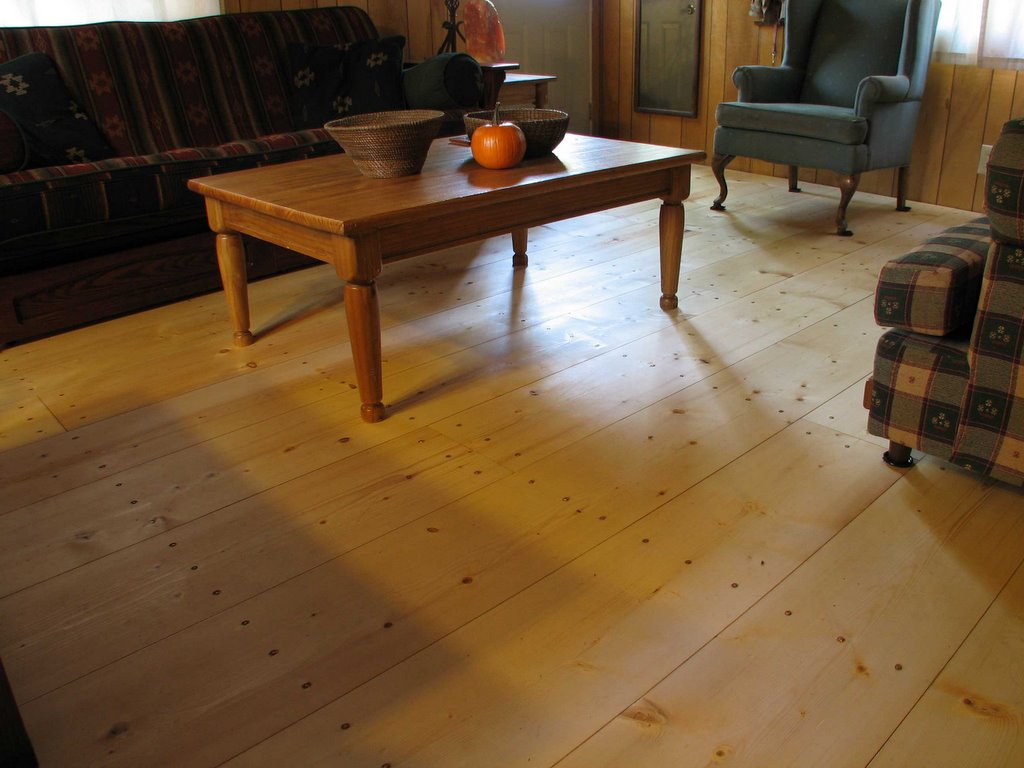
Our Finished Floor


Click on photo to enlarge

I finally finished our living room floor on Saturday morning and none too soon as it's supposed rain or snow tomorrow.

I haven't added the baseboards yet because we needed to get the furniture in off the porch before the weather hits, but I can measure those, cut & finish them outside when the weather permits, and just move the furniture a bit to nail them in place.

The floors came out nice and Peggy is very happy with them so I think I made points there!

Blogger Dread Pirate Roberts asked a couple of questions about the floor so I'll answer those here.

1. The tiny spaces between a few of the boards will collect dust and crud but cleaning & waxing will eventually seal them over.

2. Because I used standard 1" x 12" pine planks from the local lumberyard I had to consider the possibility of the wood cupping or warping so I decided to both glue and nail the planks to the plywood sub-floor. I used a non-flammable, supposedly non-toxic adhesive, Taylor's 4071 meta-tec floor adhesive, and I nailed the planks, 3 nails across, every 2 feet. I also acclimated and further dried the planks by stacking them in the house for two months with spacers between each plank to allow for air circulation. The floor is nice & flat with no signs of cupping.

The pine floor is finished with OSMO Hardwax Oil, an environmentally safe product from Germany that is non-toxic & recommended for use on children's furniture as well. It is primarily made from two waxes, carnauba & candelilla, mixed with sunflower, soybean and thistle oils and a bit of highly distilled benzene-free solvent which evaporates upon drying.

The downside is that I messed my back up again doing all that bending & lifting so it's off to the chiropractor again tomorrow.

But it's a pretty floor and as environmentally friendly as I could make it on our budget and in this location.

Labels: , , , ,

Sunday, October 30, 2005

The Planks Are Down!


Click on photo to enlarge

Finally, seven days later, the pine planks are down in the living room ready for me to start sanding them tomorrow.
I thought it would take maybe two days but I forgot about all the other stuff that needs doing around here daily.
Anyhow, sorry for the week of no posts, but I did get a few nature pictures on Saturday that I'll post above.

Labels: , , , ,

Breakfast Among The Planked Pines


Click on photo to enlarge

Peggy enjoys a relaxing breakfast among the pine planks on Saturday morning October 29th.

We had just come back from a walk to the Stanfield Marsh (photos above) and were about to resume work on the floor which is taking much longer than I expected.

Labels: , , , , ,

Sunday, October 23, 2005

Construction Zone


Click on photo to enlarge

The pine planks have been acclimating (note the air spaces between the boards) in the living room for weeks now and today I began laying the boards.

If all goes well I should have the living room floor ready for sanding by day after tomorrow.

Dallas wants his ugly green carpet back.
:~)

Labels: , , , ,

voicexml
voicexml
Creative Commons License
This work is licensed under a Creative Commons Attribution-Noncommercial-No Derivative Works 3.0 Unported License.