The Magic Bus Hobbles Along... Click on photo to enlarge © 1972-2009 jim otterstrom
 ...But The Emperor Has No Clothes.
Yep, that is definitely me---26 years old, stark naked, and in charge of an abandoned bus---while smoking a Camel, with the rest of the pack stuffed in a paper-bag turban on my head!
We are now over 37 years into the future from that moment, in October of 1972, when I made this rather amusing self-portrait.
Amusing to me now---from a decade into the succeeding century---not so much because I was still smoking cigarettes, or because I was starkers, but simply because a poorly executed photograph, recorded while spontaneously clowning around, with no forethought whatsoever, now seems almost prophetic.
I don't remember consciously trying to make a statement about peak oil or a post-petroleum world with this picture. I had merely discovered a derelict old bus at a remote burned-out homestead deep in the Santa Monica Mountains, which seemed like a perfect location for another of my irreverent photographic diatribes on the obvious (to me) consequences of our industrial civilization.
And, characteristically, I made those statements with a thumbing of my nose toward conformity, conventions, and the narrow-minded short-sightedness that I believed brought our culture to that point.
My photographs from the late-middle 20th Century often depicted blighted decaying urban or industrial locations, juxtaposed with naked humans, which I preferred to be women.
To my eyes, the lovely graceful female form lent more impact to the contrast I was attempting to illuminate between us---a single, vulnerable, mammalian species---and the ugly wreckage we were leaving in our wake as we subdued this magnificent planet.
Besides, I was a young male with a lot of lead in my pencil and the perpetuation of life on earth is all about biology, chemistry, pheremones and sexual attraction---just ask the birds, bees, and flowers---so naturally, I was quite taken with the anatomy of the opposite sex, but there wasn't a lady to be found when this picture was made, so you're stuck with me.
Where I lived, in the 1960s and early 1970s, young people spent a good deal of time naked together, outdoors, diving off rocks into secret swimming holes, or body-surfing, sunbathing, and playing volleyball at nude beach hideaways, until the gawkers, perverts, and cops discovered us.
We weren't preparing ourselves for careers, or advancement in the corporate world, we had temporarily escaped the nasty oppressiveness of materialism and competition, and were just living life to the fullest, while we could.
Change was coming though, Alvin Toffler's 'Future Shock' was written in that era, but most of us hadn't read it yet, because we liked it right where we were. Many of us had read Orwell though, and Huxley, so we had a pretty good idea of what was ahead for humanity if our civilization continued along the established path.
So, today, people of that age have their faces stuck to computer screens much of the time, fingers to the keyboard, and ears to the cell-phone, gaming, texting and tweeting in their cyberspace social networks, while constantly being electronically profiled, saturated with personalized corporate come-ons and media-hyped celebrity worship, as they're fed a steady stream of ads reeking with images of luxury, glamour, and "bling bling", that promise to make their lives more fulfilling.
All that's happening right here in the midst of a collapsing civilization now engaged in ceaseless wars over the earth's rapidly dwindling resources!
RETCH!!!
One might ask how I can be so pessimistic about our culture and yet so seemingly optimistic about life and nature?
Well, let's start with my negative outlook on our corporate owned military industrial civilization, because that perspective is the culmination of a 64 year self-guided contemporary history course.
~~~~~~
November 14th of 1945---exactly 100 days after my country dropped the world's first atomic bomb on Hiroshima, instantly incinerating 80,000 men, women, and children---I was yanked from my mother's anesthetized womb with a pair of forceps, slapped on the ass, and had a latex nipple shoved in my mouth so I could suckle a bottle of imitation breast milk until some Doc Frankenstein came along and chopped off my foreskin.
Welcome to Life, in modern America!
I got past that initial shock and started adapting to my new world, learning how to crawl, climb, and walk, in pretty short order, all of which were a big help in enabling my escape. My escape from the bars of the crib, from the playpen, from the four walls and the fenced yard. From the arguing, the bickering, the spankings, and the rules & regulations.
Fortunately for me, in 1949, when I was 4 years old, we moved from the city to the rural farming area of the West San Fernando Valley (now the porn capital of America), and my playtime quickly evolved into outside explorations of the natural world, away from people, in the company of frogs, tortoises, butterflies, birds, flowers, and creeks full of dragonflies & pollywogs.
I was in paradise, for a little while...
...but I was learning to read & write too.
All the while discovering that most activities involving other people were conducted on their terms. Someone puts a pencil in your right hand, saying, this is how it's done, so I would immediately put the pencil in my left hand, because I had my own ideas about things.
Like most kids of those days, I liked to draw, color, and paint the flowers, butterflies, bugs, and all the other magical things I saw in the natural world around me, I just did it left-handed.
Too soon, came the big yellow machines, grading, scraping, and compacting the earth, digging ditches, laying pipe, paving roads, and building houses; hundreds, and thousands, and then tens of thousands of houses. Little boxes all the same, laid out row after row, upon land I had previously shared with tumbleweeds and grazing sheep as I roamed the open prairies, the wheat fields, the vineyards, the orchards, and the rocky crags of the long lost San Fernando Valley I remember so fondly.
In fifteen years it was all gone, paved over with the destruction of progress.
By 1964, a place I loved had vanished into thin air and I was questioning everything people did, I was becoming a critic of my culture.
In school I was taught that this land of ours was once occupied by primitive savages who had to be moved out of the way to facilitate progress and development, and, by the time I was 8 or 9, I wanted to run off and live with those Indians.
Another thing I remember vividly from elementary school is seeing a cheery uplifting film, produced by a paper company, about how companies like theirs were responsibly managing America's forests, selectively cutting trees and carefully replanting, to preserve those forests in perpetuity for us, and all the wildlife which lived there. There was no mention of the clearcutting, the chemical pollutants, or the habitat and watershed destruction we would later associate with that industry.
I remember too being taught that our American democracy was a Beacon of Freedom for the rest of the world, and another specific 'educational film' still sticks in my mind, about our partnership with friendly brown neighbors to the south, in Central America, through which we exchanged their delicious tropical foods for our help in modernizing their countries.
But we didn't hear about Allen and John Foster Dulles, or the United Fruit Company (now Chiquita), or the fact that we were displacing entire populations of indigenous people from their homes and their land so a few businessmen could get rich supplying Americans with bananas, pineapple, and coffee.
And we were clueless too, about the Dulles brothers involvement in the 1953 CIA coup which overthrew Mohammed Mosaddeq, the Western friendly democratically elected Prime Minister of Iran, reinstating the Shah Of Iran, an authoritarian oil company friendly dictator, who would reign for the next 26 years, fueling the flames of the radical Islamic Revolution of 1979. That ill-conceived greed-motivated '53 coup was a mistake which would culminate in much of the terrorism we endure today, including the 9/11 destruction of the World Trade Center in 2001.
But something else was being drummed into my head at school---every month when the air-raid sirens went off, and we did our duck & cover drills, cowering under our desks---and that lesson was that the Russians were evil people who wanted to rule the world, and they were very likely going to send nuclear armed missiles to destroy our country.
We had to be prepared...
On several weekends my family actually went out window-shopping for bomb shelters. I clearly recall climbing down into those stuffy claustrophobic oversized tin cans and wondering how long I could stay in there before going crazy, or if the air filter would really keep out the radiation.
I was also taught, in Junior High School---when I was considered old enough to know about such things---that slavery was a tragic scar on American history which had been rectified by the Civil War. But I wasn't told, that, in the South, schools, restaurants, public transportation, restrooms and drinking fountains etc. etc. etc., were still segregated.
Nor was I taught---even though the Fifteenth Amendment to the Constitution had been ratified nearly a century earlier, in 1870, giving African Americans the equal right to vote---that the great majority of blacks were still excluded from voting by discriminatory State voting regulations.
None of this was in the textbooks of the 1950s, nor was it spoken of at home, and what little reporting there was on television, or in newspapers, was miniscule, biased, and trivialized.
There were no black people where I lived, in fact there were very few people who weren't as lily-white as me and my family. I had almost no multi-racial/multi-cultural experience until I was in my teens, except for one uncle who was married to a Native-American woman that actually breast-fed her babies right there in front of God and everybody else, including me. I was in awe of her!
Our 1950s world was portrayed to us on television screens, where we shared the life experiences of Lucy & Ricky, Timmy & Lassie, Ozzie & Harriet, Amos & Andy, and the Cleavers; June, Ward, Wally, 'The Beaver', and the neighborhood troublemaker, Eddie Haskell (Boy there's a double entendré innuendo for you, 'Beaver Cleaver').
These light-hearted situation comedies made us feel quite comfortable & cozy about our world of glamorous looking '56 Chevys & '57 Fords and our labor saving washers, dryers, and garbage disposals. It was all brought to us by the good folks from Kellogg (who nourished us with "wholesome" highly processed sugar-laden breakfast cereals), or General Electric (who urged us to "Live Better Electrically"), or DuPont ("Better Living Through Chemistry"), and many other fine upstanding companies.
It all looked so nice on the little black & white TV screen, while, behind the scenes, General Electric was contaminating our world with PCBs, DuPont was producing DDT (which very nearly sent Bald Eagles, Pelicans, and many other bird species to extinction), and Kellogg was morphing into part of the Frankenfood industry which today makes consumer products (I can't call it food) contaminated with GMOs, "not approved for human consumption".
Around that same time, our government was conducting experiments in biological warfare, and it was revealed---in the mainstream media many years afterwards---that my hometown, Reseda (once voted one of the 10 best places in America to raise a family), was among many other towns in the San Fernando Valley which were subjected to that experiment. We were unknowingly bombarded with mild cold or flu virus germs, released from airplanes, to test the effectiveness of spreading airborne viruses for military purposes.
I didn't know all of this at the time, but I was becoming aware enough of the real world around me to realize that much, if not most, of what was being spoonfed to me by my culture was a big stinking pile of pure unadulterated bullshit!
At this point, I not only questioned authority, I came to see our authority figures and experts as contemptible charlatans, nobody was speaking the truth!
Around 1955 or '56, we started hearing about some greasy rebellious singing hoodlum called, Elvis Presley, or 'Elvis the Pelvis' as he was known after his Milton Berle Show appearance. He was a big sensation, but not allowed to be viewed or listened to in our house, because he sang "jigaboo music" and gyrated his hips like a sex maniac!
I immediately sought out his records!
Another considerable influence on my own rapidly developing distrust and sense of rebellion was the reality of my parents divorcing when I was 12, and my diabetic father proceeding to drink himself to death by the time I was 15, in 1961.
He was 36 years old.
Then, just eight days after my 18th birthday, in 1963, President Kennedy was assassinated. Four and a half years later, Martin Luther King Jr. met the same fate, and two months after that, JFK's brother, Robert, was also killed.
By this point in time, me, and a sizable chunk of my generation had already turned on, tuned in, and dropped out!
When I made the photo above all of this ancient history was less than 10 years behind us, as fresh in my mind then as 9/11 is today.
Nixon was in the second term of his presidency, a few months away from being impeached over Watergate. He had just removed the dollar from the gold standard because America was too deep in debt from the Viet Nam War to be able to pay off our foreign obligations in gold.
The war was raging full-steam as draft-age American kids rioted in the streets, and four students at Kent State University had been gunned down by our own National Guard during an anti-war demonstration just a couple of years earlier, in May of 1970.
1970 was the same year America reached Peak Oil production (exactly on schedule with Marion King Hubbert's much ridiculed 1956 prediction), which received very little press in light of everything else that was going on in the country, I don't even remember hearing about it at the time.
Then, precisely one year after the above photograph was made, in October of 1973, the Arab members of OPEC, along with Egypt and Syria, began an oil embargo against the United States (related to American support of Israel), driving gasoline prices up something like 400% and creating fuel shortages, long lines, and gas rationing all across the country.
The embargo lasted 5 months and life in America would be changed forever...
"The 1973 oil price shock and the resulting 1973-74 stock market crash are said to be the first events since the Great Depression to have a persistant economic effect" (from Wikipedia).
Inflation (or stagflation---high prices and a stagnating economy), tied to rising energy costs, was the bane of the 1970s and early '80s.
That got people's attention, and cash-strapped Americans began buying inexpensive, fuel-efficient, foreign-built compact cars in large numbers, causing considerable consternation to the Big Three domestic automakers. GM, Ford, and Chrysler cried foul play and demanded government intervention which eventually resulted in import quotas on Japanese cars.
Buy American backlash gripped the country and budget-minded fuel-conserving owners of foreign cars (like me) were labled as traitors by some of our more over-zealous patriots.
The roots of road rage had been sewn...
It was also becoming quite obvious that American manufacturers couldn't compete with the cheap labor markets we had long exploited once these developing countries had their own modern industrial economies in place. So we began exporting our technology, and our jobs, leaving once thriving factories and towns to decay into the poverty-stricken rust-belt wastelands they are today.
One solution to the rising oil prices was the Trans-Alaska Pipeline, completed in 1977, 4 years after the Arab Oil Embargo. The pipeline, over the past 32 years, has conveyed a total of 16 billion barrels of oil from Prudhoe Bay to Valdez, Alaska, enough to supply America for about 26 months, and the Prudhoe Bay reserves are now in steep decline.
In 1989 the Exxon Valdez spilled 11 million gallons of that oil into Prince William Sound, killing between 250,000 and 500,000 seabirds, 1,000 Sea Otters, 300 Harbor Seals, 250 Bald Eagles, 22 Orcas, 12 river otters, and billions of salmon and herring eggs, not to mention the ruination of a pristine ecosystem.
Are Americans willing to accept that scale of environmental destruction for 26 months worth of oil (or maybe 52 months by the time the wells are dry)? Apparently so!
Over the past 37 years, since this picture was taken, we've endured no less than 6 recessions and a sober look into the causes reveals that oil prices played a central role in each of them.
Petroleum is the trump card upon which our entire economy is founded and the myriad of intertwined vested interests who speculate (gamble) in a stock market based on artificial currency can be brought down in minutes by any hint of instability.
And our economic house-of-cards is anything but stable...
Economic pressures, tied to energy prices and inflation, drove reactionary California voters, on June 6th, 1978, to pass Proposition 13 (the Jarvis Tax Amendment) which virtually destroyed the State's economy and infrastructure, including our school systems, police, and fire departments. California's education system went from being among the top 5 in the nation to among the bottom 10 in very short order. And the tax burden of my parents generation (who benefitted greatly from the property value gains they accrued during the inflationary years) was simply transferred, in multiples, to the shoulders of my generation who were also paying highly inflated interest on our mortgages.
In the early 1980s, during Ronald Reagan's deregulation years (America's most cherished president), we descended from the world's largest creditor nation to a debtor nation, and by 2006 we would be the world's largest debtor nation.
So the redistribution of wealth, from the working-class to the upper-class---once so skillfully manipulated by the robber-barons of the late 1800s & early 1900s---was reborn and supersized, as was the the political polarization between the rich and the poor, and between 'so-called' conservatives & liberals (so-called because the conservatives don't conserve & the liberals don't liberate).
In times of economic crises, when upward mobility is out of reach of the average person and resources are scarce and expensive, the ultra-rich and powerful quickly expand their holdings to become even more so. Today, as during the Great Depression, surviving companies are in a feeding-frenzy over the corpses of their former competitors, buying them up as fast as they can (often with taxpayer dollars).
Consequently, you might notice, the market for exotic super-high-dollar luxury cars is booming right now, while the rest of the industry is either bankrupt or teetering on the edge.
As of 2005, out of 30 industrialized countries studied, the U.S. had the 3rd highest inequality and poverty rate, with Mexico at number 2 and Turkey at number 1.
As billionaires increase in numbers, and corporations become bigger and more powerful, that power is used to exert more control over the governments of the world by demanding less regulatory oversight, which leads to more social and environmental irresponsibiliy, and less accountability.
Over these past 37 years we've also witnessed countless corporate caused disasters of unprecedented magnitude, such as industrial accidents, oil spills, toxic waste spills, and economic meltdowns.
Details of many of these tragedies are engraved in my memory and they're also readily accessible on the internet for anyone who cares to educate themselves about the hard realities of our civilization.
There's no need for me to repeat all the gruesome details here, but I will post links to a few of them in case someone is interested in a refresher course.
1978 The Italian Dioxin Crises (Roche)
1978 Love Canal (Hooker Chemical/Occidental Petroleum)
1978 AMOCO Cadiz Oil Spill (AMOCO)
1979 Three Mile Island (Metropolitan Edison-Babcock & Wilcox)
1984 Bhopal Disaster (Union Carbide)
1985 Savings & Loan Crisis (deregulation)
1986 Chernobyl (regulatory failure)
1986 BSE Crisis-Mad Cow Disease (regulatory failure)
1988 Piper Alpha Platform Explosion (Occidental Petroleum)
1989 Lincoln Savings Bankruptcy (Charles Keating/Keating 5)
1989 Junk Bond Scandal - (Michael Milken)
2000 Dot-Com Bubble (venture capital speculation)
2001 Enron Bankruptcy (Kenneth Lay - accounting fraud)
2008 The U.S. Housing Bubble & Subprime Mortgage Crisis (deregulation)
2009 Bernie Madoff Securities Fraud (regulatory failure)
2009 General Motors & Chrysler Bankruptcies ("The Great Recession")
OK, so those are just a sampling of the most memorable anthropogenic calamities of the past several decades, and they truly only hint at the destructive chaos reverberating exponentially throughout our economies, our ecosystems, and our civilization as a whole.
The cost of all this to our society in economic terms is staggering and our descendents will be paying for our stupidity for generations to come.
But the real tragedy is the destruction we're wreaking upon the living diversity of this planet. 20% of mammal species, and 25% of bird species are expected to be extinct before the end of the century. Many of the worlds fisheries have already crashed and many more are on the brink. Our air and water is polluted, even in the most remote parts of the world, and our climate is warming, melting the polar ice, and raising sea levels.
All of this is being hastened by a single species which has lost its bearings and no longer has the capability of living sustainably upon the planet it evolved from, and with.
It should be easy to hate such a selfish and destructive species, but I can only find empathy and compassion in my heart for my fellow humans.
I can see that, as a civilization, we are quite helpless at this point to reverse the momentum (or even slow it significantly) that is leading us toward collapse and die-off. A hundred years from now our population, as well as the plentiful bounty we inherited, will have been severely decimated.
I have instinctively felt this my entire adult life and nothing I've witnessed in 64 years has done anything but intensify that feeling.
Nevertheless, I can't live a life dominated by doom & gloom, people want to enjoy their lives, and I'm no exception.
Like everyone else I need to experience happiness and joy in my heart, to know beauty and love.
After a very difficult adolescence, trying to come to terms with the awful mess the world was in, I turned back to nature, to pollywogs, butterflies, and banana slugs, where I rediscovered the beauty I desperately needed to survive amidst the ugliness of my civilization.
Once I immersed myself in the natural beauty around me again, for the first time since childhood, I also began encountering thoughtful sensitive human beings, mostly through their writings or conservation work, kindred souls who share my love of the natural world and abhor its destruction.
Now, all those shining lights among my species are too numerous to list here, but I want to acknowledge the ones that stand out right this moment.
First and Foremost
~ Bob Dylan ~
Because the bard of my generation long ago refreshed my ability to listen and to think, and he still does!
And then there's
John Muir
John Lennon (Imagine)
Edward Abbey
Henry David Thoreau
Gandhi
Rachel Carson
Aldo Leopold
Dave Foreman
John Burroughs
Gary Paul Nabham
E. O. Wilson
William R. Catton
Charles Darwin
Arne Naess
Wendell Berry
Alexander Von Humboldt
David James Duncan
Charles Francis Saunders
Bill Devall
David Quammen
Stephanie Mills
George Sessions
David W. Orr
Paul Shepard
Barry Lopez
Richard Heinberg
Gary Snyder
Peter Matthiessen
John Michael Greer
Without these voices, and so very many others, my spirit would've perished many years ago and surely taken my body with it.
They helped restore my faith in humanity and expanded my capacity for love and compassion.
Wild Nature, and lover's of the wild & natural, are the most inspiring companions I've found during my continuing journey through parts of two centuries.
And my empathy for all concerned stems from the realization that we're all victims trapped in the same out of control vehicle.
A civilization is simply a vehicle created to get you from one place to another, from yesterday to tomorrow, so to speak. A few civilizations have traveled several millenium before running out of gas, and a few very old ones haven't perished yet.
Today's industrial civilization burst upon the scene barely 250 years ago, as we began taking advantage of the energy available in refined coal, one of our most abundant fossil fuels. But things didn't really get rolling for another century when Colonel Edwin Drake drilled the first oil well in the United States, in Titusville, Pennsylvania, in 1859, exactly 150 years ago.
I'm 64, and have witnessed unimaginable changes during my life, and I remember much of it as if it were yesterday. If you simply double my current lifespan, you get 128 years, add another 22 years and we're back to the dawn of the Petroleum Age.
Basically, the day before yesterday on the scale of human history, or a fraction of a second in geological time.
During that blink of an eye, by best estimates, we've used up about half the oil available to us, oil that was millions upon millions of years in the making, and the half we've used was the stuff that was easy to procure, thus cheap to produce.
Modern civilization is completely dependent upon the kind of growth enabled by that cheap abundant energy source, it's how Capitalism and the economic myth of unlimited growth came into dominance.
Planet Earth now harbors more than 6.5 billion souls whose survival requires the perpetuation of an obsolete system on the brink of collapse.
We are always led to believe, by those who make lofty political promises, by those who can afford to make glitzy media presentations, by those who want to sell us something, that our future is rosy if we'll just knuckle down long enough to get over the current hump.
Well, we're at the apex of a hump now alright, and ironically, it very much resembles the hump of that Arabian Dromedary Camel on the cigarette pack in my turban. Our hump is known in peak oil circles as the Hubbert's Peak Bell Curve, and we are about to slide down the slippery slope of its backside, and things don't look so rosy.
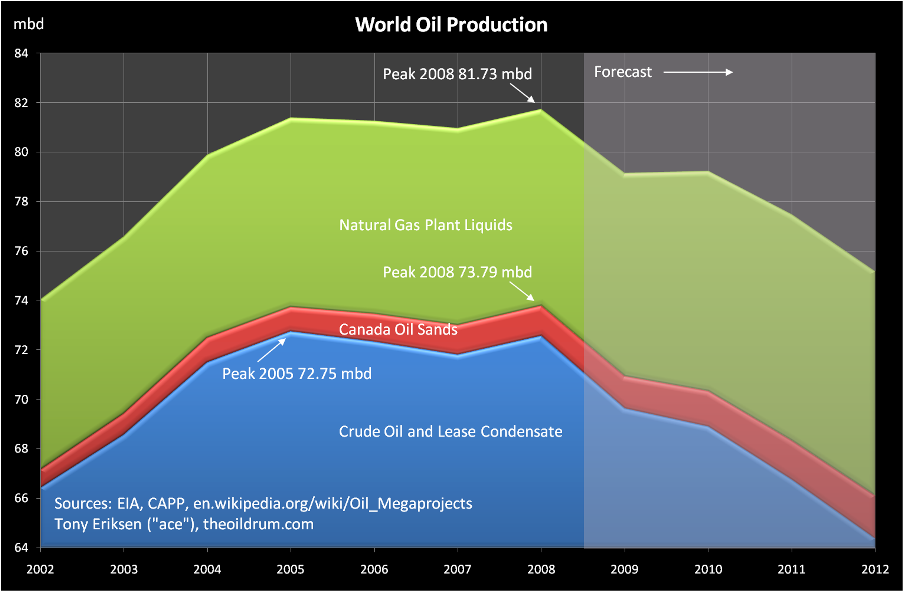
World oil production has recently peaked (see chart), 39 years after America reached peak oil production in 1970.
Our civilization, the vehicle we are currently traveling within, is steered by emperors who would have us believe that we ride a magic bus, exempt from the laws of nature or any limits to growth.
But the truth of the matter is, our magic bus is just a broken down heap, headed for the junkyard, and the emperor has no clothes once again.
Journal entry
December 15, 2009
© 2009 jim otterstrom
Labels: climate change, disasters, mythology, nudes, peak oil, rants, social commentary
 Click on photo to enlarge - © jim otterstrom 2009/2010